Share
Endava: The Company Where Technology Evolves and People Grow Alongside It
26.02.2026
6 min
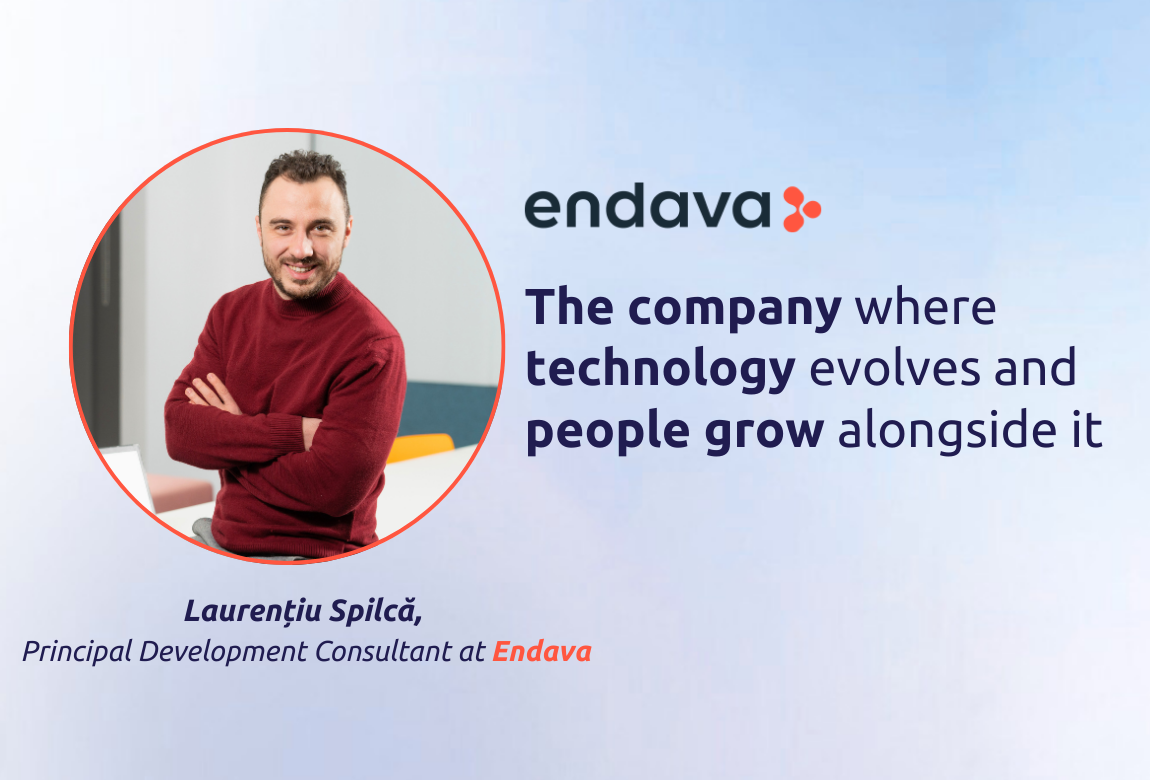
We resume our series of articles dedicated to companies that offer real opportunities for professional growth based on trust, autonomy and balance. Today we are speaking with Laurențiu Spilcă, Principal Development Consultant at Endava, a professional with almost 9 years in the company and an active voice in Romania’s tech community.
We discuss his professional journey, technical leadership, the evolution of Java, impact, AI, and what a work environment looks like in practice when performance and autonomy go hand in hand.
1. You have almost 9 years at Endava. Looking back, when was the moment you most clearly felt that you were in the right place professionally?
Honestly, I think I realized it fairly quickly. I liked the environment from the very beginning: the people, the vibe, the fact that I was already doing things I enjoyed. After almost 9 years, I can say that I’ve also “grown professionally older” here, in the good sense of the term — the transition from “I’m learning how things work” to “okay, now I can help others learn too.”
I’ve always had challenges interesting enough to keep me from getting bored, but also support when things became complicated. I think you know you’re in the right place when you realize the years have passed and you still come to work with pleasure. For example, when you start your day with a coffee and a chat with your colleagues before opening your laptop, provided there are no urgent matters, of course.
2. What does your day-to-day work as a Principal Development Consultant look like in concrete terms, and what kinds of challenges do you most enjoy solving in the Java space?
Although it may sound a bit unexpected for a management role, I haven’t given up coding, nor do I want to. I still enjoy writing code and staying connected to the practical side of things. It’s true that, compared to a few years ago, the actual time spent coding has decreased, because today I juggle many more types of tasks each day. Some days are more intense, others calmer, but over time a balance forms.
The part I enjoy the most is working with people. I like discovering solutions together, helping others grow using what I’ve learned, and at the same time continuing to learn from colleagues and clients.
In the Java area, the challenges that attract me most are those where you need to find simple solutions to complex problems: distributed systems, performance, data consistency, or situations where you must translate business needs into technical solutions that truly work in production. And when you see that the solution genuinely helps people and improves the product, that’s when real satisfaction appears.
3. Java has evolved significantly in recent years. What changes do you consider most important for teams developing robust applications today, and how are these changes felt in real projects?
Java has evolved a lot and, more importantly, it has evolved consistently. I like to think of Java as an ecosystem that grows organically, without sudden changes that disrupt everything you previously built. In my career, I’ve gone through system upgrades from Java 6 all the way to Java 25, so I’ve had the opportunity to directly see how the platform has changed.
That gives you a fairly healthy perspective: Java is no longer just a language — it is a mature platform, with well-established tooling, runtime, and practices.
If I had to choose the most important directions of recent years, I would say maintainability and performance. We now have a more expressive, clearer language, easier to maintain within large teams, and the improvements in the JVM greatly help optimize resources. At the same time, security has remained a priority, and this is visible both at the platform level and within the ecosystem.
In real projects, these changes translate simply into code that is easier to read years later, more efficient applications that are easier to run at scale, and fewer compromises between speed, stability, and safety. In practice, they help us build robust systems without feeling like we’re fighting the platform.
4. You’re also well known in the community for the way you explain difficult concepts in an accessible manner. How has that helped you in leadership, and how does it translate into the way you work with teams?
In reality, I’ve learned and continue to learn by helping others learn. I see the entire process more as a circle than as an arrow moving in a single direction. Often, I’m able to explain concepts simply precisely because I’ve come to understand them very well by explaining them to others — whether through YouTube, books, articles, or conferences.
In leadership, this translates directly. Communication and the ability to explain are essential because, in reality, a leader shouldn’t give orders but rather create the context in which the team can work independently and make good decisions.
For me, the balance of success appears when the team no longer depends on me to move forward. When you are no longer the point through which every decision must pass, and you’re no longer the bottleneck everyone looks to for direction, that’s when you truly begin to build leadership. That’s what I aim to achieve in every project: autonomous, confident teams capable of continuing to grow, regardless of the context.
5. If you had to choose one example of impact you’re proud of at Endava, what would you choose?
I don’t think I can reduce impact to a single thing and, honestly, that’s what I’m most proud of. In almost nine years, I’ve constantly tried to bring positive change, and I intend to continue doing so.
I’ve led teams that delivered successful products across various domains, from Payments and Credits to Retail and Logistics. I’ve contributed to improving the way we work by adjusting guidelines and ways of working. I’ve delivered training sessions and presentations which, I hope, have helped many colleagues grow and deliver more value to clients.
Perhaps the most important thing is that I’ve had the opportunity to do all of this. That says a lot about the organization’s culture. Not everywhere are you given the space to have real impact and support your ideas. At Endava, I’ve always felt there is room to try, to propose, to build. When you feel you’re not limited by context, the desire to contribute more comes naturally. For me, that’s what makes the difference.
6. In a market where AI is rapidly changing how code is written, which skills will matter most for a Java Engineer in the coming years?
It’s a difficult question, because the future doesn’t come with release notes. But if I had to bet on something, I would bet on the ability to continuously learn. Sometimes I’m surprised by the idea that there’s no point in learning anymore because AI already does everything. I don’t believe in that direction.
I believe the developers who will be most successful are those who haven’t given up on learning but have learned how to use AI as an accelerator, not a replacement.
The real difference will come from taking technical responsibility. AI can generate code, but it cannot be responsible for it. And responsibility only exists if you understand what happens behind the scenes: architecture, trade-offs, security, performance, business impact.
For a Java Engineer, that means remaining very strong on the fundamentals while also using AI to increase speed and delivery quality. Not thinking less, but building more, faster — and being aware of what you’re building.
7. For someone considering their next career step, how do you know that a role and a team are the right fit?
For me, the first thing I look at is a healthy balance between work and personal life. It may sound simple, but the reality is that health outweighs any bonus or title. People who are well, rested, and motivated tend to deliver better and more consistently.
I would recommend looking for a company with a culture that encourages continuous growth, offers decision-making freedom, and respects the balance between professional and personal life.
Concrete questions worth asking:
-
How is learning and upskilling supported in practice?
-
How much real autonomy do teams have in technical decisions?
-
What does a typical day look like for someone on the team?
-
How is success measured: only by fast delivery, or also by quality and sustainability?
-
What happens when things go wrong — are people blamed, or are solutions sought?
In the end, you know you’re in the right place when you feel you can grow professionally without giving up who you are outside of work. For me, that has always made the difference.
Would you like to learn more about Endava as an employer?
If you’re interested in what Endava’s culture looks like beyond projects and technologies, explore the company’s employer page on Undelucram.ro, read colleagues’ reviews, and discover the open opportunities.
And if you want to visit the company’s careers page, perhaps your next professional step starts right here.
Share
What I read is worth it:
Read all the articles about
Undelucram interviews Leadership skills Workforce planning Organizational excellence Employee experience StudentsArticle written by:
 Undelucram.ro
Comments
0 comments
No comments! Be the first to comment on this article!

Access your account and add your comment
Undelucram interviews


Subscribe to the Newsletter
Read articles of interest from Undelucram.ro contributors
