Share
Minimum Wage in Romania in 2026: Current Level, Evolution and Outlook
28.11.2025
4 min

In recent years, the national minimum wage has become one of the most important indicators for Romania’s labour market. It directly affects more than one million employees and puts pressure on company costs, while also serving as a political and social instrument used to protect the incomes of the most vulnerable workers. In 2025 and 2026, Romania entered a new phase: the minimum wage is higher, the rules for setting it are clearer, and as of 1 January 2026, the calculation method already follows the new European mechanism of the “adequate minimum wage.” In this context, authorities decided on a new increase in the gross minimum wage, which will come into force on 1 July 2026, continuing the trend of gradual adjustments to minimum incomes.
1. What is the minimum wage in 2026 and to whom it applies
In 2026, the gross national minimum wage in Romania will be increased starting 1 July, after remaining at the 2025 level during the first part of the year. Thus, from 1 January to 30 June 2026, the minimum wage is set at 4,050 lei, followed by an increase to 4,325 lei from 1 July 2026.
The minimum wage applies to all full-time employees, regardless of sector, except for industries that benefit from special minimum wage schemes, such as construction. The minimum wage represents the gross base salary guaranteed by law, established by government decision, and does not include bonuses, allowances or other salary supplements.
For the first half of 2026, the tax incentive applied to the minimum wage is maintained, positively influencing the net income of employees at this level. The fiscal mechanism will be adjusted once the new wage level enters into force in July.
2. How the minimum wage evolved in recent years (2022–2025)
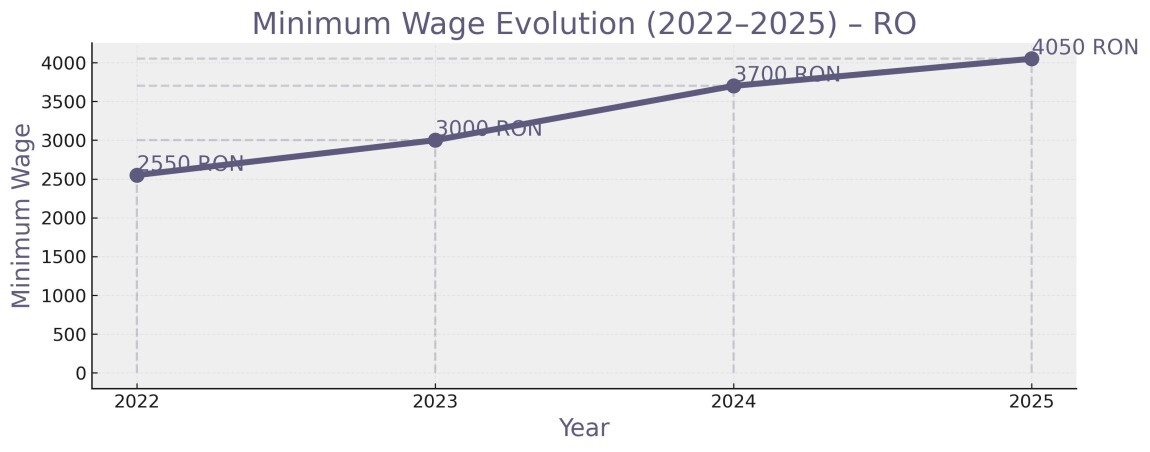
The period 2022–2025 has been one of the most dynamic in terms of minimum-wage developments. In 2022 the minimum wage stood at 2,550 RON. In 2023 it increased to 3,000 RON and later to 3,300 RON toward the end of the year. In 2024 it rose again to 3,700 RON, and in 2025 it reached 4,050 RON. These rapid increases were driven by inflationary pressure and the objective of aligning Romania with European standards for adequate minimum wages. At the same time, the transposition of the 2022 EU Directive introduced the requirement that the minimum wage be updated annually based on objective indicators such as cost of living, productivity and overall wage dynamics.
3. What the minimum wage looks like in practice in 2026 (gross, net, taxes, employer cost)
In the first half of 2026, a gross minimum wage of 4,050 lei generates a net salary of approximately 2,574 lei, taking into account the standard deduction and the continued application of the 300 lei tax-exempt allowance. The total cost for the employer slightly exceeds the gross amount, as it includes the labour insurance contribution.
Starting 1 July 2026, once the gross minimum wage increases to 4,325 lei, the employee’s net income rises accordingly, reaching approximately 2,699 lei, depending on how the tax incentive is applied. At the same time, the cost borne by the employer increases, reflecting the higher gross wage and related contributions.
This adjustment results in a slightly higher net income for employees, but also an additional cost for employers, who must absorb the legislated increase. The figures presented apply to employment contracts paid at the general minimum wage level, without additional benefits or fiscal exceptions.
4. The 300-RON tax exemption in 2026: how it works
In the first half of 2026, the tax incentive allowing 300 lei of the gross minimum wage to be exempt from income tax and social contributions remains in place. This results in a higher net salary compared to the standard calculation formula.
Starting 1 July 2026, together with the increase of the gross minimum wage to 4,325 lei, the tax incentive will be adjusted, with the tax-exempt amount reduced to 200 lei. This change directly affects the resulting net salary, even though the gross wage level is higher.
The incentive applies only if the employee’s base salary is exactly the legal minimum wage and if the job represents the employee’s main employment. The measure remains a fiscal support tool for low-income workers, although its impact is limited and varies depending on the period of the year.
5. Sectors with special minimum wages (construction and others)
In addition to the general minimum wage, Romania maintains in 2026 a special minimum wage for the construction sector, where the minimum level is higher than the national minimum wage. This threshold reflects the strategic importance of the construction industry, as well as support measures introduced in previous years to address labour shortages and stimulate investment.
Throughout 2026, the special minimum wage in construction remains distinct from the general minimum wage, regardless of the July increase, and continues to apply to employees in this sector in accordance with current regulations.
By contrast, other sectors that previously benefited from differentiated minimum wages, such as agriculture and the food industry, remain aligned with the general minimum wage following the removal of specific tax incentives. As a result, construction remains the only sector with a distinct minimum wage nationwide in 2026.
Conclusions
The year 2026 confirms the continued upward trend of the minimum wage in Romania, in a context marked by high living costs and gradual alignment with European rules on adequate minimum wages. The level of 4,050 lei is maintained in the first part of the year, while the increase to 4,325 lei from 1 July 2026, together with the application and adjustment of the tax incentive, brings a moderate benefit for employees but also represents an additional cost for employers.
Construction remains the only sector with a differentiated minimum wage, while updated legislation makes 2026 a transition year toward a more predictable and standardised system. If the current pace is maintained, further adjustments to the minimum wage may follow in the coming period.
Share
What I read is worth it:
Article written by:
 Undelucram.ro
Comments
0 comments
No comments! Be the first to comment on this article!

Access your account and add your comment
Legislative


Subscribe to the Newsletter
Read articles of interest from Undelucram.ro contributors
