Share
How to break the graduate experience trap: 3 legal routes that work in Romania
24.08.2026
9 min

You graduated two months ago. You open a job platform, filter for "no experience required," apply to 40 listings and get two replies, both saying "sorry, we need at least one year of experience." You call a friend from your course: same story. You stare at the listings and wonder where you're supposed to get that experience if nobody will give you the chance to earn it.
The bad news: the market really has tightened. Youth unemployment among 15–24-year-olds in Romania hit 28.8% in the first quarter of 2026, according to INS (Romania's National Institute of Statistics), more than four times the overall unemployment rate. HR consultants confirm that fewer and fewer companies are hiring juniors, and the IT sector, which looked like a sure thing a few years ago, has largely stopped opening entry-level roles.
The good news: Romanian law gives you THREE forms of legally recognised professional experience that you can start this week, without a standard individual employment contract. These aren't workarounds, they're statutes. And 97% of Romanian students never use them, which means anyone who does stands out immediately. Here is the roadmap.
Step 1: Internship contract (Law 176/2018), paid, and it counts as seniority
Forget "unpaid internship for experience." Since 2018, that arrangement is only legal in the form regulated by Law 176/2018, and the regulated form means money in your account and credited work seniority.
The exact figures you can put on the table in any conversation:
- Minimum allowance: 50% of the national gross minimum wage. With the minimum wage set at 4,325 RON gross (the level in force from July 2026, established by Government Decision HG 146/2026), that means at least 2,163 RON gross per month, for up to 40 hours per week.
- Duration: a maximum of 720 hours, spread over no more than 6 months. It cannot be extended.
- Seniority: the internship period counts as work seniority and, where applicable, as seniority in your field of specialisation. That means you already have genuine "experience" on your CV, not a polite fiction.
- Minimum age: 16 (or 15 with parental consent), so the law applies even if you are still in your final year of university.
The golden hook most students miss: if the host organisation hires you on a standard individual employment contract within 60 days of the internship ending and keeps you for at least 24 months, it receives a state employment-promotion bonus of 4,586 RON (Law 176/2018, Article 22). That is real cash for them. Companies with up to 20 employees may take on a maximum of two interns at the same time; larger organisations are capped at 5% of total headcount. Competition for these spots is genuine but finite. Apply early.
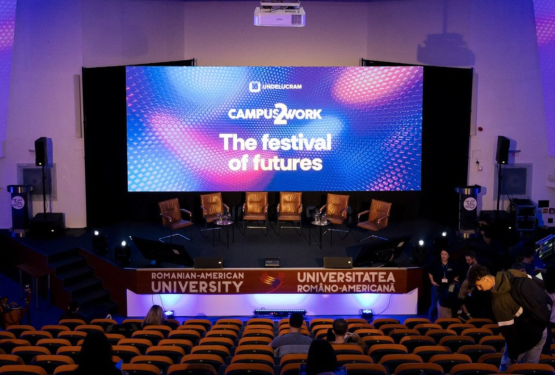
Where to look: start with Undelucram.ro, where you can explore job listings, internships and company information drawn directly from employees' own experiences. And if you want to escape the cycle of applications sent into the void, consider Campus2Work – The Festival of Futures, the Undelucram.ro event aimed at students and young people at the start of their careers, where you can speak directly with employers, attend workshops and get a clearer picture of the options available to you.
Step 2: Volunteering contract (Law 78/2014), a legally recognised certificate of experience
Volunteering does not put money in your pocket, but it gives you something an internship cannot always offer: freedom to choose your field and no 5%-of-headcount quota per employer. You can start anywhere that will take you, as soon as tomorrow.
Here is the part recruiters know but few candidates use correctly. Under Article 10(2) of Law 78/2014: "Volunteer activity shall be regarded as professional and/or specialist experience, depending on the type of activity, if it is carried out in the field of the studies completed. Volunteer activity shall not be regarded as work seniority."
In plain terms: it does not increase the seniority recorded in your employment record, but it legally fills the "professional experience" section of your CV. When a recruiter says "you have no experience," you produce a volunteering certificate bearing an official letterhead that says otherwise. This is not semantics, it is a regulated official document.
What to do concretely this week:
- Choose a field that aligns with your degree. Volunteering on an environmental campaign does not count as specialist experience if you studied accountancy. Look for NGOs doing work adjacent to your profession: financial literacy, communications, pro-bono IT, public health, law.
- Ask for a written contract. Without a signed volunteering contract under Law 78/2014, you have no document. You have a promise.
- Request the volunteering certificate at the end. Issuing it is the organisation's legal obligation. That certificate is what you put on your CV.
Step 3: Register with ANOFM within 60 days of graduating
This is the step almost nobody takes, and the most expensive one to miss. You have a legal window of 60 days from graduation to register with the ANOFM (Agenția Națională pentru Ocuparea Forței de Muncă, Romania's National Employment Agency). Miss that deadline and you lose the entire package described below.
What registration unlocks, provided you are over 16 and meet the eligibility conditions:
- Graduate unemployment benefit: paid for 6 months, at 50% of the Social Reference Indicator (ISR). With the ISR at 660 RON, that works out to 330 RON per month. Modest, but it can run in parallel with an internship. You are not eligible if you are already employed, attending full-time courses or if you turn down a job suited to your qualifications.
- Free qualification and retraining courses through ANOFM programmes. You can earn a technical certification at public expense before you land your first job.
- Job-placement bonus (prima de inserție) of 1,980 RON (3 × ISR): awarded if you take up full-time employment and stay with the same employer for at least 12 months. It is paid in two equal instalments of 990 RON each, the first on the date of employment, the second after 12 months, under Law 76/2002.
- Commuting / mobility bonus: if you take a job more than 15 km from your home address, you receive 0.5 RON per kilometre, capped at 55 RON per working day, for 12 months, worth up to approximately 1,100–1,200 RON per month on top of your salary if you commute every day.
When you receive your first job offer and look at the proposed salary, calculate first what you will actually take home after social contributions, then add the job-placement bonus and mobility bonus to the monthly picture. On a gross salary of 5,000 RON, the difference between having worked this out correctly and letting a recruiter confuse you can amount to several thousand lei over the course of a year.
The verbal toolkit: what to say to a recruiter in an interview
This is where the game shifts. When a recruiter says "our budget for juniors is 3,500 RON net" or "we don't really hire without experience," you don't plead. You put numbers on the table. Three phrases you are entitled to use, because they are backed by law:
- "If you hire me on an internship contract and keep me for 24 months, the company receives a state bonus of 4,586 RON under Law 176/2018." That is cash in their pocket. The figure works as a business argument, not an appeal for sympathy.
- "I hold a volunteering contract under Law 78/2014 in field X, which the legislation explicitly recognises as professional specialist experience." You remove the "no experience" objection. You are not debating, you are citing a legal article.
- "I am registered with ANOFM as a graduate and I qualify for the job-placement bonus. The minimum gross salary I can accept starts at [figure], because anything below that cancels the state benefits." You anchor your salary request in a legal framework, not a personal wish.
According to HR consultants, starting salaries for graduates in 2026 range between 3,500 and 5,000 RON net, depending on the sector. Finance, healthcare and sales are still hiring at entry level; BPO, call-centre, retail and hospitality are the sectors hit hardest by contraction, so your bargaining power is weaker there. Know your market and benchmark the offer against comparable roles and industries before you sign.
What NOT to do: the traps that cost you money
- Do not accept an "unpaid internship for experience." It has not been legal since 2018. If someone proposes this, it is undeclared work dressed up in a PR-friendly name.
- Do not let the 60-day ANOFM registration window lapse. You will lose the unemployment benefit, the job-placement bonus and the mobility bonus. The total lost package can exceed 5,000 RON in your first year.
- Do not accept a volunteering arrangement without a written contract. Without a document issued under Law 78/2014, it is not legally recognised professional experience, it is free labour.
- Do not sign your first contract without calculating your net pay. A "5,000 RON" figure in an offer may be gross or net, and for a junior the difference in take-home pay is nearly 2,000 RON. Ask explicitly and verify it yourself.
Campus2Work: where the vicious cycle starts to break
Every step above is useful: the internship, the volunteering contract, the ANOFM registration, the right questions at interview, checking your salary and reading the fine print before you sign anything. But there is a practical obstacle that remains: as a student, you often never get close enough to employers to have those conversations in the first place.
That is where Campus2Work – The Festival of Futures comes in, the Undelucram.ro event dedicated to students and young people at the start of their careers.
Campus2Work is not a traditional career fair where you walk past stands, drop off a CV and hope someone calls. It is designed more like a festival experience for your professional future: with a main stage, workshops, direct interactions with employers, activations, challenges and resources that help you understand what comes after university.
Why does this matter if you have no experience? Because it gives you exactly what online applications usually lack: context, conversation and direct contact with people inside real companies. You can find out which entry-level roles exist, what employers actually look for in a junior candidate, which internship programmes are available, which skills are worth developing and what the first months in a job genuinely look like.
Registration is not just a standard form either. It is designed as a game-style mini-journey: you create your profile, shape your future-self character, answer questions about your career direction, upload your CV, connect with the community and accumulate prize-draw entries as you take concrete steps towards your career. In other words, you start building your professional path before you even arrive at the event.
Think of Campus2Work as a concrete step in your career strategy: you talk to employers, ask about internships, find out what "no experience" really means for each company, discover roles you might never have considered and leave with clearer ideas for your CV, your interviews and your next applications.
In short: if you have no experience, don't wait for it to appear on its own. Go to the places where you can start the conversations that lead to experience.
Register here: Campus2Work – The Festival of Futures.
Your action calendar for this week
Monday: visit the ANOFM branch in your home district (județ) with your degree certificate or official graduation confirmation. Check whether you qualify for the graduate unemployment benefit, the job-placement bonus, free training courses or the mobility bonus. Do not let the 60-day deadline slip past.
Tuesday: register for Campus2Work – The Festival of Futures and start building your Future Profile. It is not just a standard form: you create a career character, fill in details about yourself, choose skills, answer orientation questions and begin mapping your professional journey. You are taking the first step and accumulating prize-draw chances as you complete actions on the platform.
Wednesday: contact two NGOs or organisations in your field of study about a volunteering arrangement with a written contract. Ask directly whether the activity is conducted under Law 78/2014 and whether you will receive an official volunteering certificate at the end.
Thursday: return to the Campus2Work platform and continue your journey: upload your CV, connect with the community, join the dedicated group, browse the available workshops and note down what you want to get out of the festival, for example, talking to employers, finding out about internship programmes, understanding which entry-level roles exist or leaving with clearer ideas for your CV and interviews.
Friday: prepare three questions for employers. For example: "What does experience actually mean for an entry-level role at your company?", "Do you run paid internship programmes?", "Which skills matter most for a junior hire?" or "What do the first few months look like for someone just starting out?"
Weekend: update your CV. Add university projects, volunteering, certifications, courses, relevant activities and anything that shows you have done something concrete. Then check salaries and comparable roles on the Undelucram.ro Salariometru so you don't walk into an interview with a number picked at random.
Three legal steps, one week of action, and up to approximately 8,700 RON in legally unlocked subsidies and allowances, plus a "professional experience" section on your CV backed by real contracts. Add Campus2Work to the equation and you are no longer searching purely from behind a screen: you arrive face to face with employers, workshops, entry-level roles and conversations that can turn a first step into a genuine opportunity. The rest is up to you.
Share
What I read is worth it:


Read all the articles about
Students Legislative Job opportunities Negotiation Internships and volunteering Career planning CV Resources Editorial Employee experience Motivation and vocationArticle written by:
 Undelucram.ro
Comments
0 comments
No comments! Be the first to comment on this article!

Access your account and add your comment
Students

Subscribe to the Newsletter
Read articles of interest from Undelucram.ro contributors
